
Wednesday at 7x24 Exchange opened with Jay Paidipati, who leads energy and sustainability programs at Uptime Institute, the organization behind the Tier standard. His talk was titled “Energy Management in AI Data Centers: What’s the Same and What’s Different?” His real argument was simpler: you can't manage what you can't see, and most sites can't see enough.
Power got expensive, and it's staying that way
His opening slides were about money. Grid upgrades and commodity volatility have pushed power costs up for two years, and colocation customers are asking about it. As presented, from Uptime's surveys:
- 64% of colo providers expect to raise power prices to customers within two years.
- Power is the top spending-increase priority for colo providers, up from 37% in 2024 to 43% in 2025.
- For enterprise operators, the cost of power per kWh was the single biggest unit-cost increase in both years.
Demand isn't slowing either. Uptime's estimate, built from seven studies, has global data center energy use roughly tripling from about 500 TWh in 2025 to 1,400 TWh by 2035, with AI inference the fastest-growing slice.
AI changes the building, not just the bill
Paidipati's comparison of AI and standard compute was a good map of what operators are now living with:
- 10–20× the power and cooling per rack, with coolant distribution units on the floor.
- Power that swings. Training loads can step up toward most of a system's rating at once, which, in his words, "will require infrastructure for power quality management."
- Heavier racks, more gray space per square foot of white space, and leak detection as a standard concern.
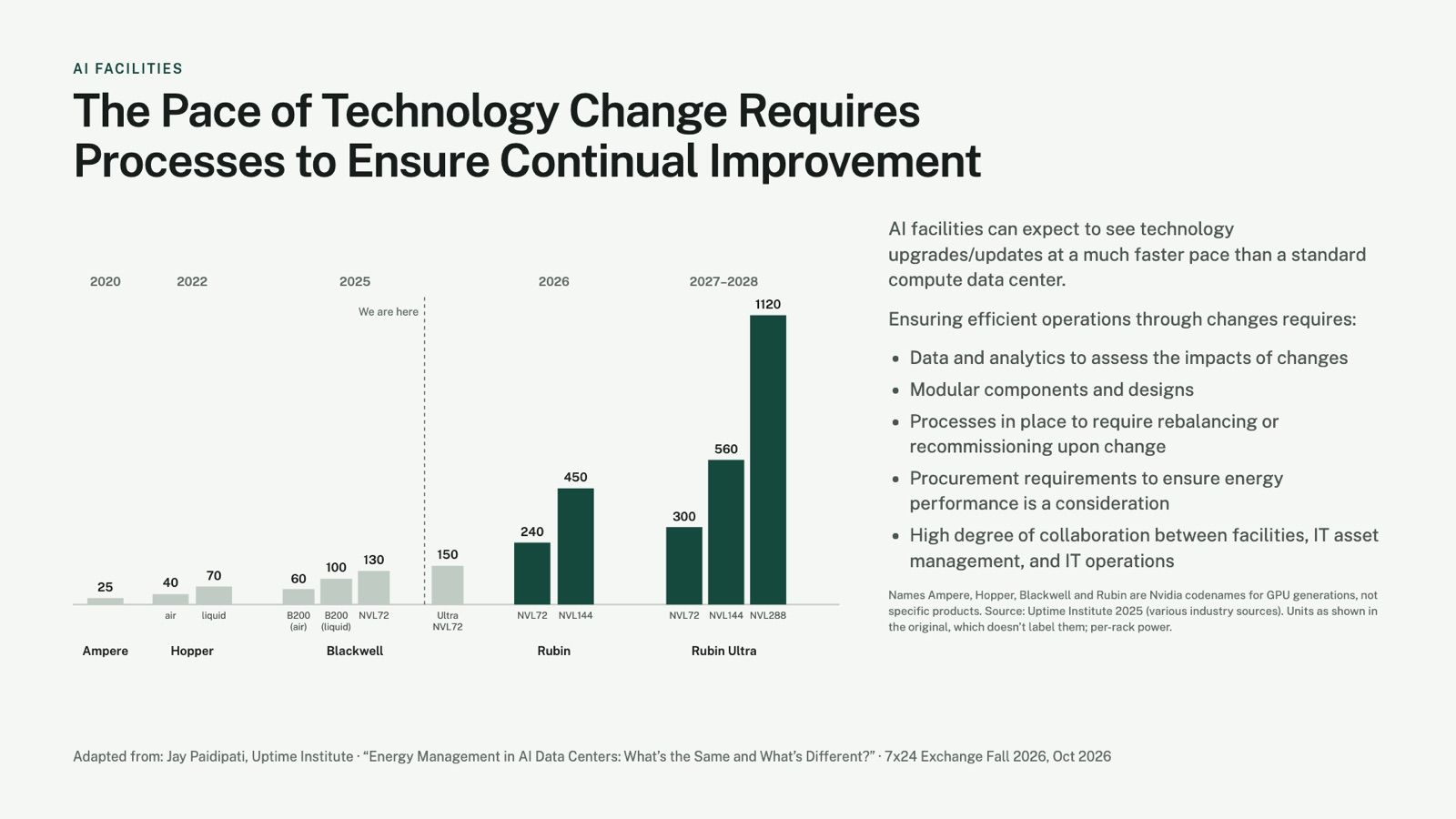
- A moving target. Rack power has climbed with every GPU generation, from the tens of kilowatts toward a projected megawatt-class rack before the end of the decade. Each step means rebalancing or recommissioning.
Adapted from Jay Paidipati, Uptime Institute, 7x24 Exchange Fall 2026.
The list that matters
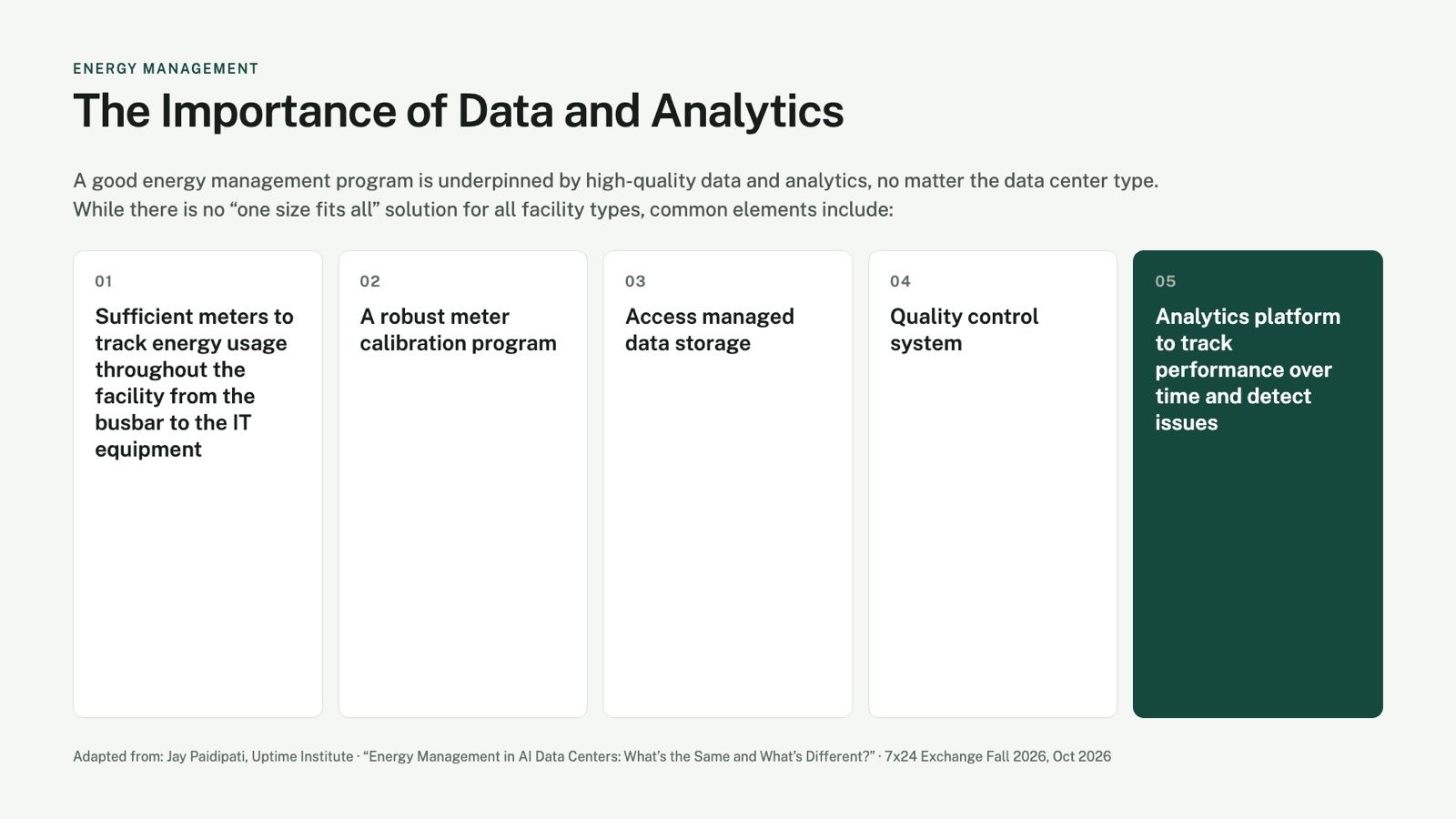
The slide we'd frame on the wall listed what a good energy management program rests on, whatever the facility:
- Enough meters to track energy from the busbar to the IT equipment
- A real meter calibration program
- Access-managed data storage
- Quality control on that data
- An analytics platform that tracks performance over time and detects issues
Adapted from Jay Paidipati, Uptime Institute, 7x24 Exchange Fall 2026.
Then he made the uncomfortable point: energy performance drifts. A site commissioned to a good PUE doesn't stay there on its own. Setpoints wander, utilization changes, equipment ages. ISO 50001's plan-do-check-act cycle exists because a one-time audit can't catch drift.
People are the other half
Uptime's outage data, as presented: about two-thirds of outages involve human error, often misconfigured cooling, power or setpoints that waste energy too. 85% of those trace back to skipped or flawed procedures, a share that rose again in Uptime's 2025 outage analysis. Roughly 65% of operators struggle to hire or keep facilities staff. And many organizations Uptime works with, he said, have neither the dedicated staff nor the plan that energy management takes.
What we took from it
His conclusion led with high-quality data and tracking the right metrics, ahead of staffing, asset management and continual improvement. For AI sites he added on-site generation, power quality management, a process for constant technology change, and closer work between facilities, IT and the business.
It's the case for continuous, read-only visibility into the systems an operator already runs: catching drift as it happens, flagging the misconfigured setpoint before it becomes an outage or a bill, and answering "what does this IT change do to our power and cooling?" before the change lands.