
The subtitle of Dr. Nathan Kamphuis's session at 7x24 Exchange was "An Adventure in Profit Maximization," and he meant it. Kamphuis, who leads advanced systems and commissioning at ImpactCx (a Salas O'Brien company), spent an hour arguing that the parts of a data center we treat as overhead (cooling, waste heat, idle capacity) can be turned into revenue.
Efficiency won't shrink the bill on its own
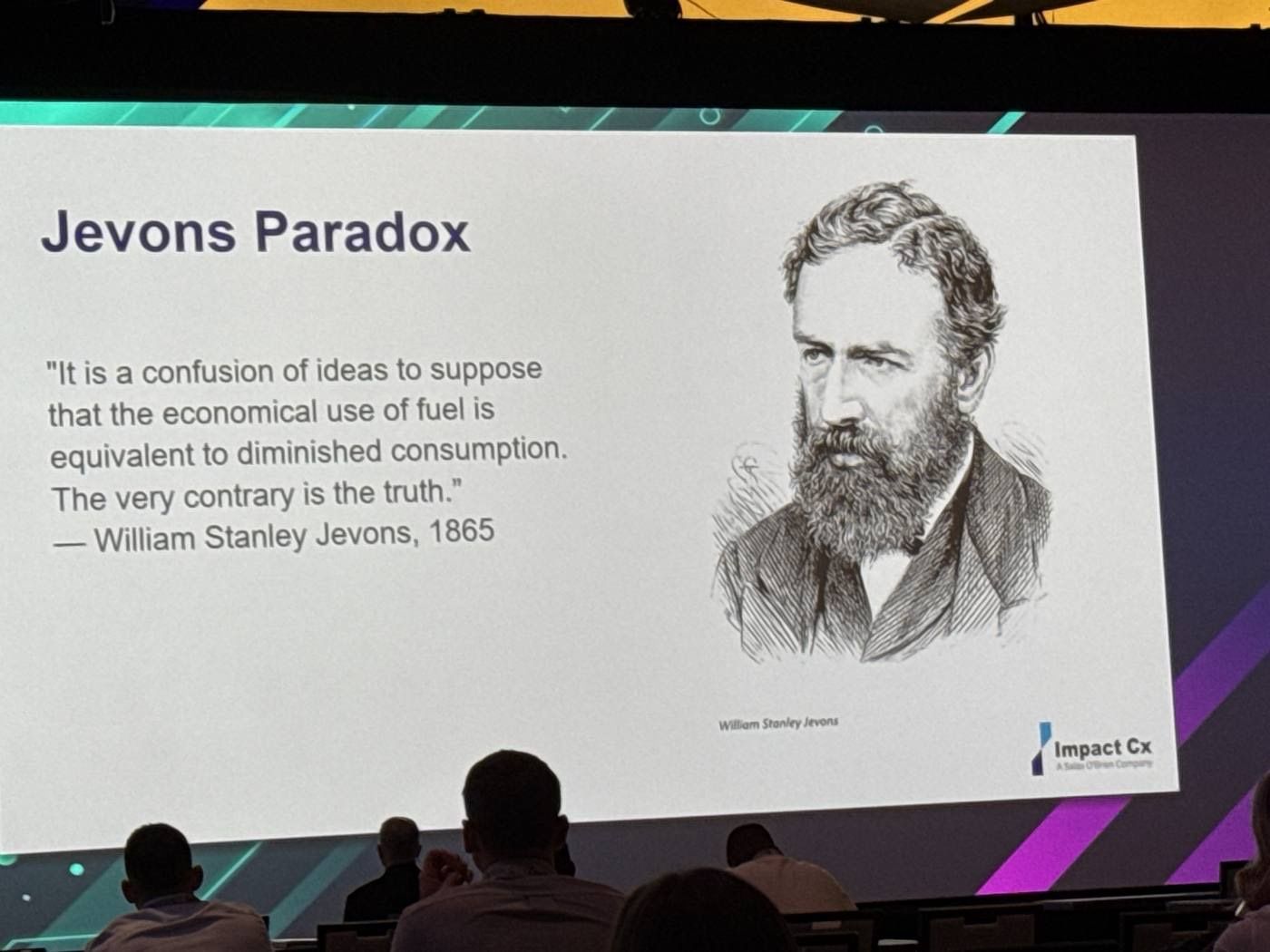
He started with a 160-year-old warning. William Stanley Jevons, 1865: "It is a confusion of ideas to suppose that the economical use of fuel is equivalent to diminished consumption." Every data service gets more efficient per unit over time, and demand grows faster. Efficiency matters, but it's how you do more with the power you have, not how you use less.
Nathan Kamphuis (ImpactCx), 7x24 Exchange Fall 2026, photographed from the audience.
Why 45 °C water matters
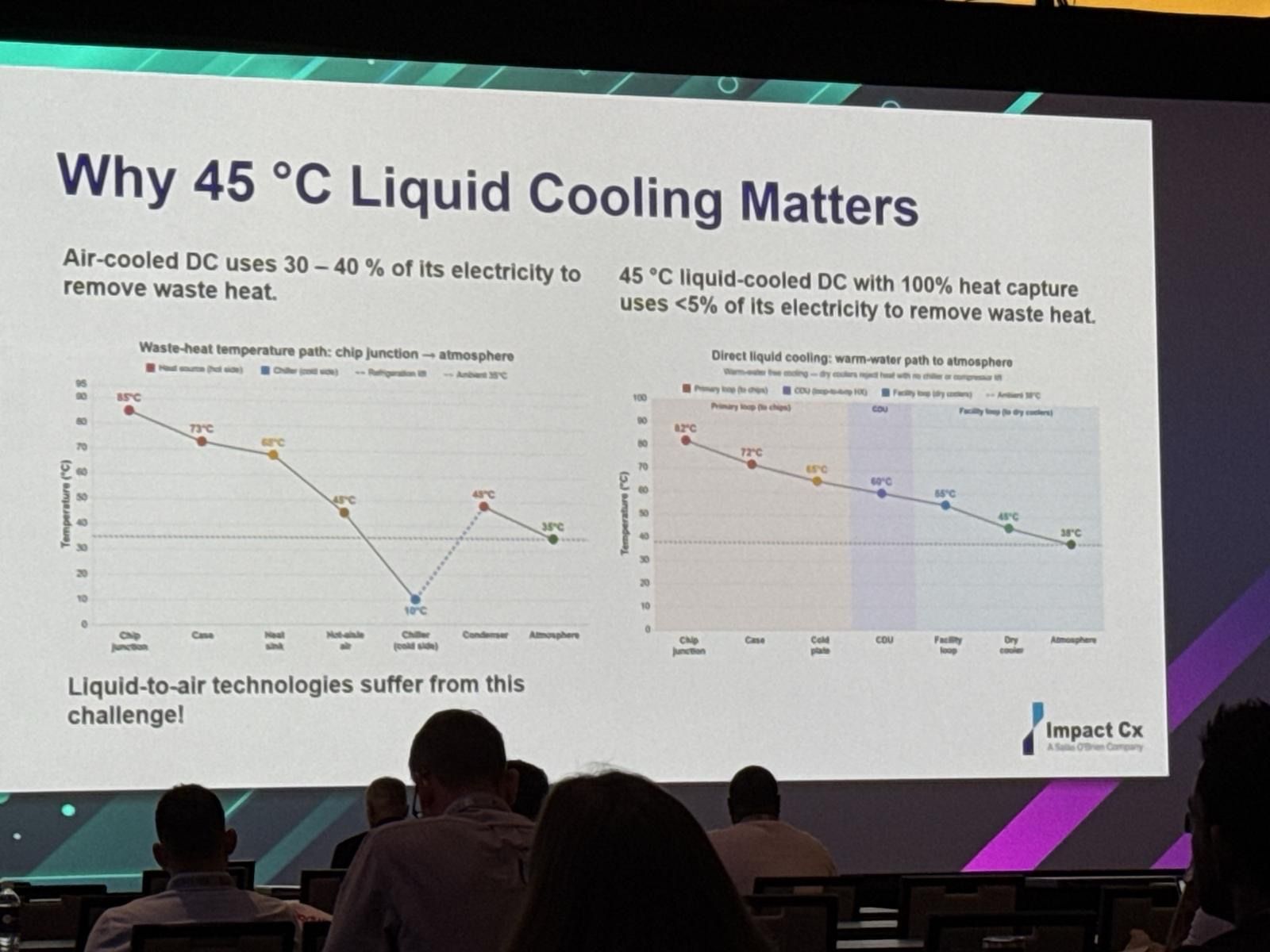
His clearest slide traced heat from the chip to the outside air. In an air-cooled hall, heat is pulled down to chilled-water temperatures, below the outdoor air, and then pumped back up past it to be rejected. That refrigeration lift is where an air-cooled site spends, as he presented it, 30–40% of its electricity just removing heat.
Run warm-water direct liquid cooling at around 45 °C and the heat stays above ambient the whole way. Dry coolers can reject it with no chiller, and his figure for a liquid-cooled site with full heat capture was under 5%.
Nathan Kamphuis (ImpactCx), 7x24 Exchange Fall 2026, photographed from the audience.
Push the water warmer still and the waste heat becomes worth something. Around 70 °C, it can drive single-effect absorption chillers that make chilled water from heat. Most industrial heat demand, citing the IEA, sits at or below 200 °C. His prediction: within a year, someone runs a data center that cools itself with its own waste heat. His ask to chip buyers: demand higher safe junction temperatures and better thermal connection to the cooling loop, because that's what raises the value of the heat.
Three upgrades, one hard problem
For existing facilities he named three moves:
- Warm-water liquid cooling, for the reasons above.
- 800 V DC distribution, cutting conversion stages between the grid and the chip. He put the gain at about 2.5% in a new build and up to 7.5% against a 15-year-old facility.
- More efficient compute, with ARM processors now mainstream for AI.
Together, he argued, the same power and floor space could deliver several times the compute. The catch is everything else: floors that can't carry truck-weight racks, revenue lost while a hall is offline, new arc-flash hazards at the rack, and the biggest one, the risk of losing your utility interconnection if you demolish and rebuild. His suggested path: retrofit a small slice of the floor first, migrate workloads, then do the rest.
A city's worth of load
He made the scale concrete. A 10 GW campus averaging around 8 GW draws about 70 TWh a year; by his team's corrected modeling, that exceeds all but a handful of US urban areas. At that size the grid treats a facility like a utility, and grid operators are writing rules to match.
The opportunity he pointed to: the 20 to 50 highest-demand hours a year. Shift load away from those and you free interconnection capacity that otherwise sits idle for the sake of a few peaks.
The brownfield campus
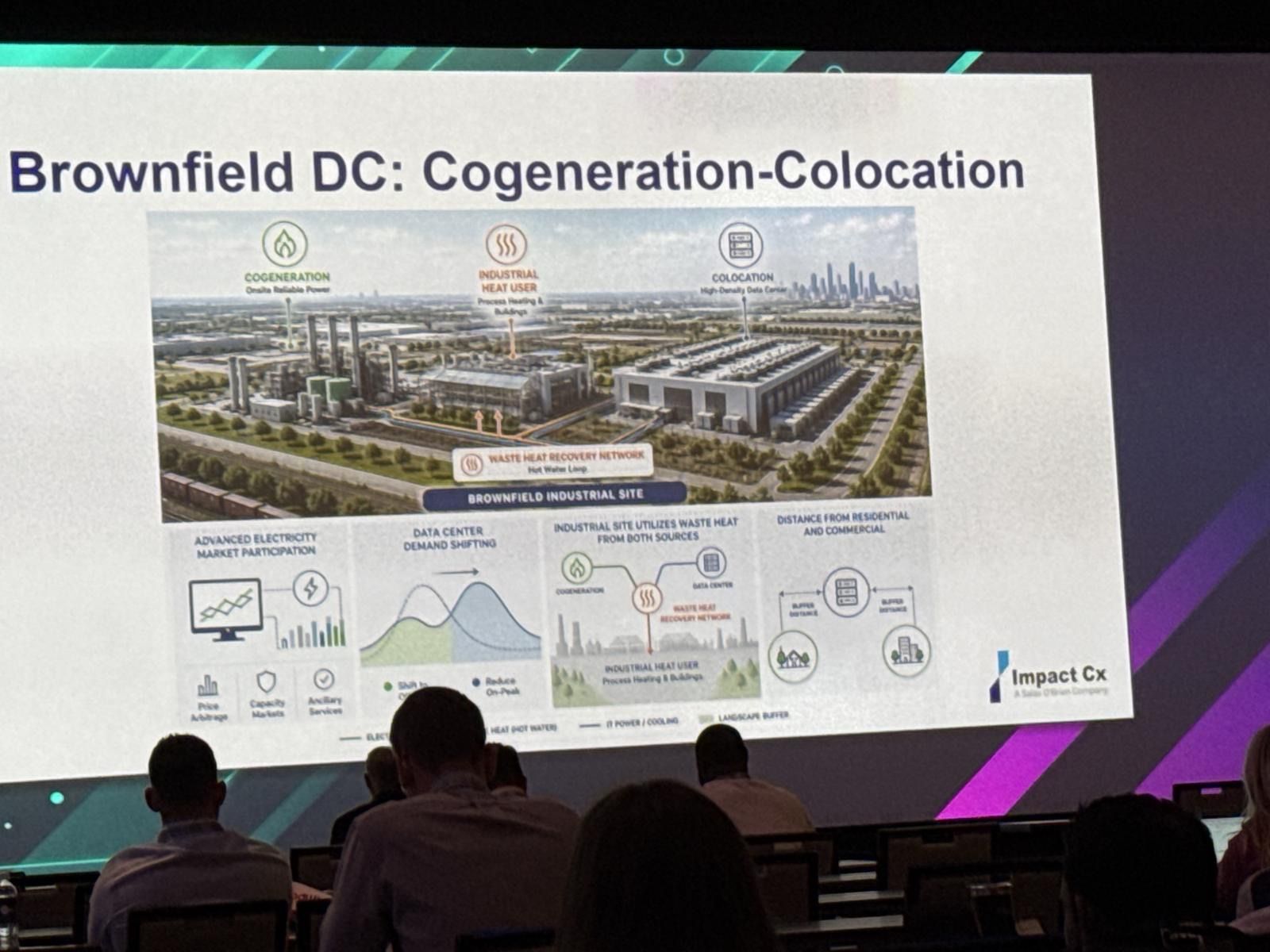
His closing design put it all on one site: a brownfield industrial parcel with on-site cogeneration, a high-density data center, and an industrial neighbor that buys the waste heat from both. Add a steam turbine to a simple-cycle gas turbine and efficiency climbs from roughly 40% toward 60–65%. Sell flexibility into capacity and ancillary-service markets. Keep a landscape buffer between the site and its residential neighbors.
Nathan Kamphuis (ImpactCx), 7x24 Exchange Fall 2026, photographed from the audience.
His three-rung ladder for heat:
- Recover and upgrade waste heat on site.
- Co-locate generation and co-generate.
- Supply heat to an adjacent industrial user.
What we took from it
Every rung of that ladder depends on the same thing: knowing, hour by hour, how much heat at what temperature a site really has, which hours it can flex, and how much headroom is left before a retrofit is forced. That's facility data and a model of the building, and it's the difference between a heat-reuse idea and a heat-reuse contract.