
Four sessions at 7x24 Exchange Fall 2026 made the same argument from different directions. The cheapest place to find a data center problem is on paper. The next-cheapest is in a model. The most expensive is in operations. For retrofits and capacity additions, "planning" increasingly means a model of the real building.
The number
The DCE 9000 panel (Google, Holder and Schneider Electric, moderated by Gino Tozzi) put a cost curve on it: a defect costs 1x to fix at the factory, 10x at installation, 50x at L4/L5 commissioning, and 100x in operations, where it shows up as arc flash, downtime and SLA breaches. Their line: early compliance "isn't a bureaucratic cost; it is an insurance policy for the construction schedule."
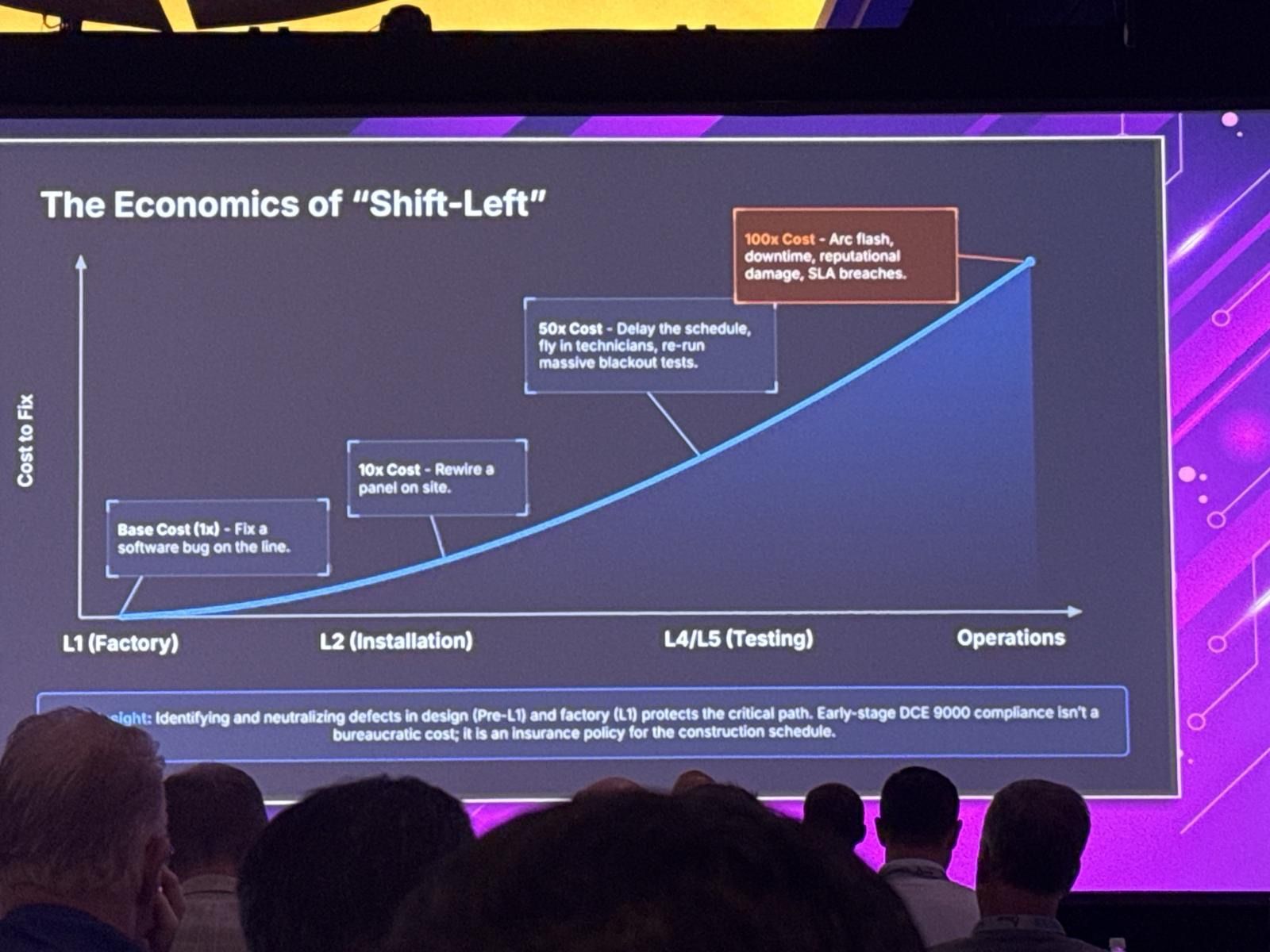
The DCE 9000 panel (Google, Holder, Schneider Electric), 7x24 Exchange Fall 2026, photographed from the audience.
Design, not procurement
- Compass and Siemens' replication playbook starts with step 1: "bring infrastructure partners in during design, not at procurement." The MV skid arrives 70–80% commissioned from the factory.
- The DCE 9000 panel's fifth failure mode: flat 2D drawings miss equipment clashes and blocked maintenance access, discovered at L2 rigging. The fix is full 3D modeling before fabrication.
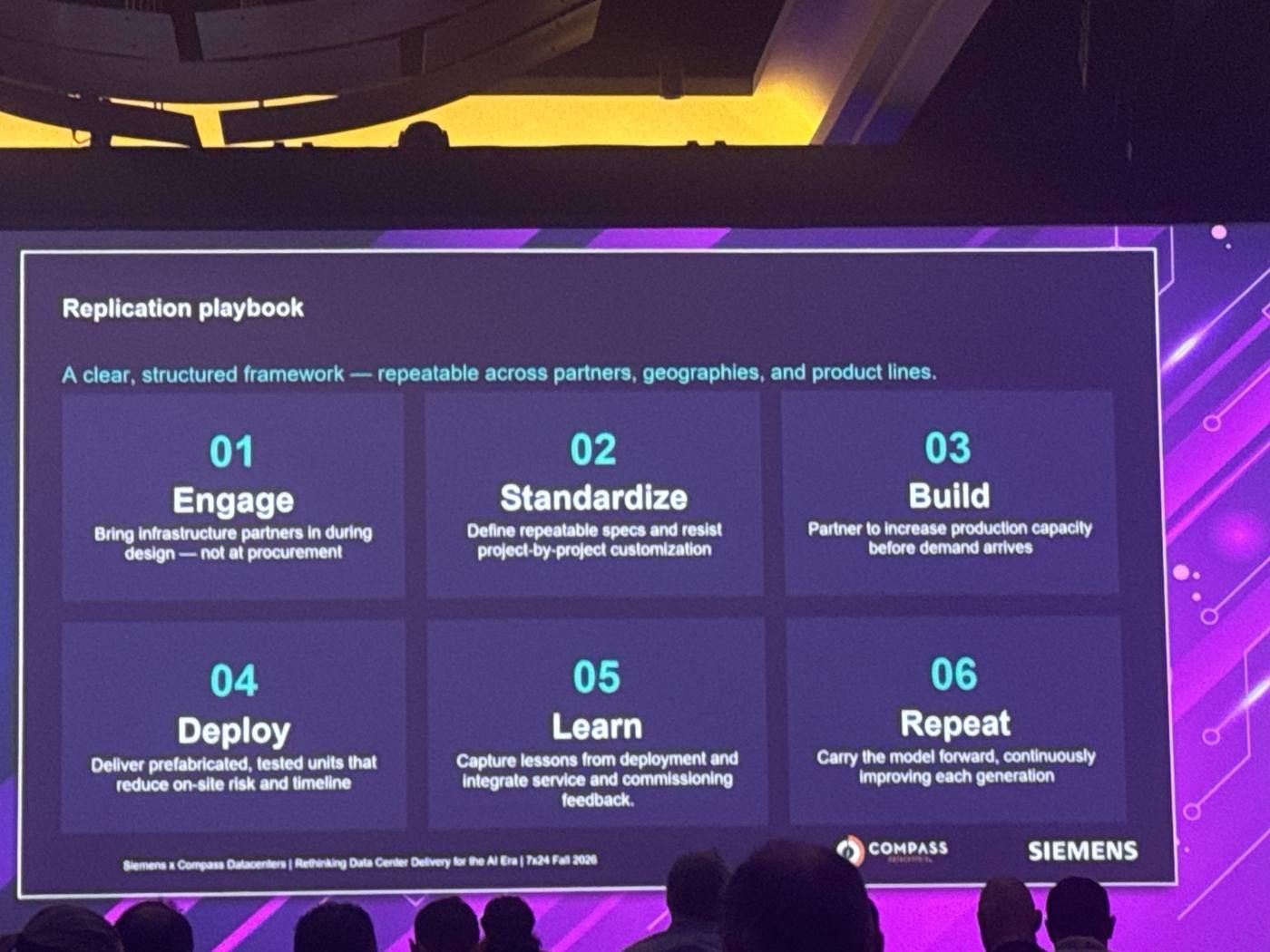
Compass Datacenters and Siemens, 7x24 Exchange Fall 2026, photographed from the audience.
The failures that hide until the end
The panel's second failure mode is BMS mapping failures and telemetry drops, which today are only found at L4/L5.
Retrofits start from the building you have
Legacy Investing, Syska Hennessy and Gardner Builders walked through converting a 1988 enterprise data center to 20 MW of AI with tenants still running, plus a late-stage tenant swap to a different technology stack.
Here, "planning" can't mean drawings alone. It means a calibrated model of how the existing power and cooling actually behave, built from the site's own BMS and EPMS data.
The grid is moving it into planning too
IEEE and NERC (Veronika Rabl, Janette Sandberg): NERC's computational-load standards, expected to be approved by the end of 2026, would require data centers over 50 MW to provide models before hookup, report operating status and measure continuously. IEEE P4200 adds uniform model and data requirements for interconnection. The plan now includes a model the utility can use.
What planning can't reach
The same cost curve puts the 100x defects in operations. From the keynote (Nabeel Mahmood): "We hold power and cooling to five nines. We let agentic systems run at compounding error rates we haven't agreed how to measure."
Shift everything you can left, then verify the rest continuously once the site is live.