
Tuesday's keynote at 7x24 Exchange Fall 2026 opened on a big frame and landed on a small, sharp question.
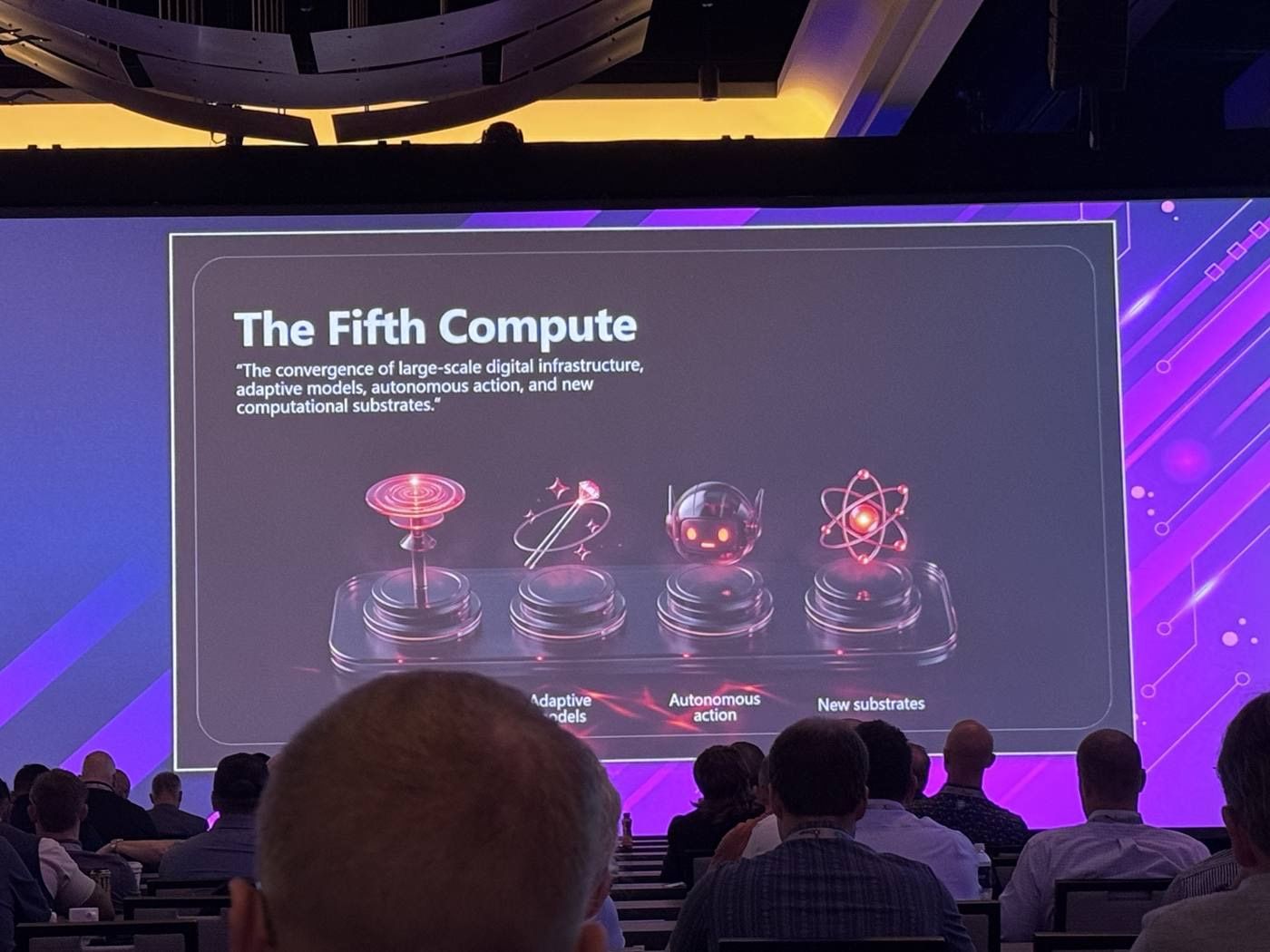
Nabeel Mahmood (Nomad Futurist) called the moment the Fifth Compute: after fire, mechanized labor, electricity and digital information, the convergence of large-scale infrastructure, adaptive models, autonomous action and new computational substrates. Then he drew the line that mattered for the room. Intelligence and agency are not the same thing. A calculator gives you an answer. An autonomous system decides and acts, and when it acts inside a facility, its mistakes stop being confined to a screen.
Nabeel Mahmood's keynote (Nomad Futurist), 7x24 Exchange Fall 2026, photographed from the audience.
The metric nobody has yet
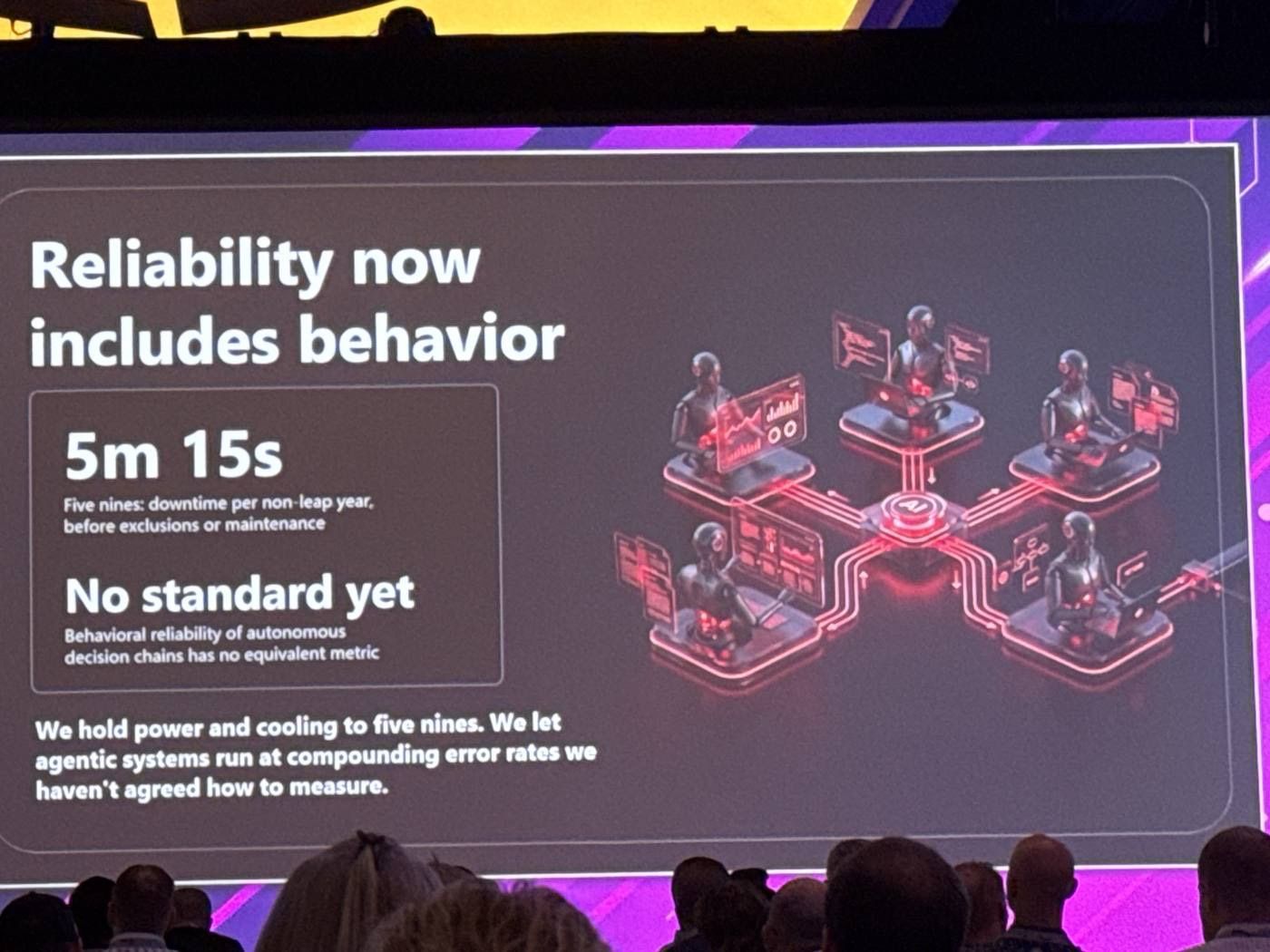
The slide that stayed with us put two numbers side by side. Five nines of availability allows about 5 minutes and 15 seconds of downtime a year. For the behavior of autonomous decision chains, there is no standard at all.
"We hold power and cooling to five nines. We let agentic systems run at compounding error rates we haven't agreed how to measure."
Nabeel Mahmood's keynote (Nomad Futurist), 7x24 Exchange Fall 2026, photographed from the audience.
That's the gap. Every operator in the room can tell you their uptime. Almost none could tell you how often an automated system in their facility made the wrong call, or how those calls compound when several systems adjust power and workloads at once. Mahmood's example: three systems, each making a reasonable adjustment, together producing instability. Individually rational, collectively a problem.
Four questions before anything acts on its own
He framed autonomy as a ladder, from recommendation up to systems coordinating other systems, with the risk changing at every rung. The question isn't whether a system is smart enough to act. It's whether the conditions exist for it to be allowed to:
- Who defines its boundaries?
- Who verifies its decisions?
- Who intervenes when it's wrong?
- Who remains accountable?
It's a good checklist for any tool that touches a live facility, and a fair one to hold us to.
The constraints are physical
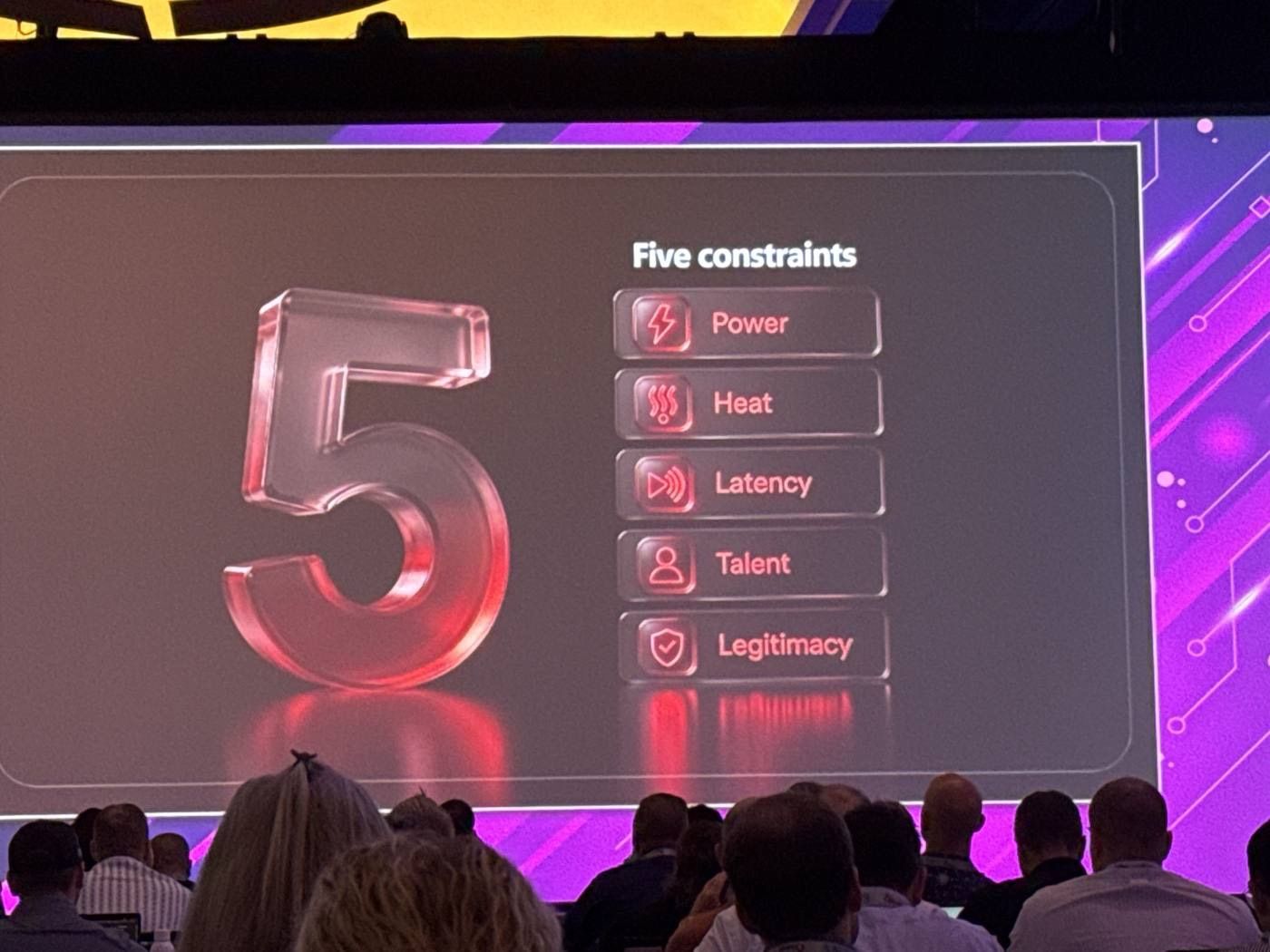
The more capable the software, the more it leans on the physical world. His five constraints: power, heat, latency, talent and legitimacy.
Nabeel Mahmood's keynote (Nomad Futurist), 7x24 Exchange Fall 2026, photographed from the audience.
- Cooling is a continuum, not a cliff. Air, direct-to-chip liquid and immersion each have a place as density rises. The decision is when, not whether.
- Talent doesn't scale like power. As presented from Uptime's 2025 survey, 46% of operators report trouble finding qualified candidates and 37% trouble keeping them. "You can't build your way out of a workforce shortage the way you build your way out of a power shortage." His call to action was to write down what senior operators know before it walks out the door.
- Legitimacy has to be maintained. A community grants permission to build once. The trust to keep operating is earned for decades, in plain language about energy, water, grid impact and jobs.
What we took from it
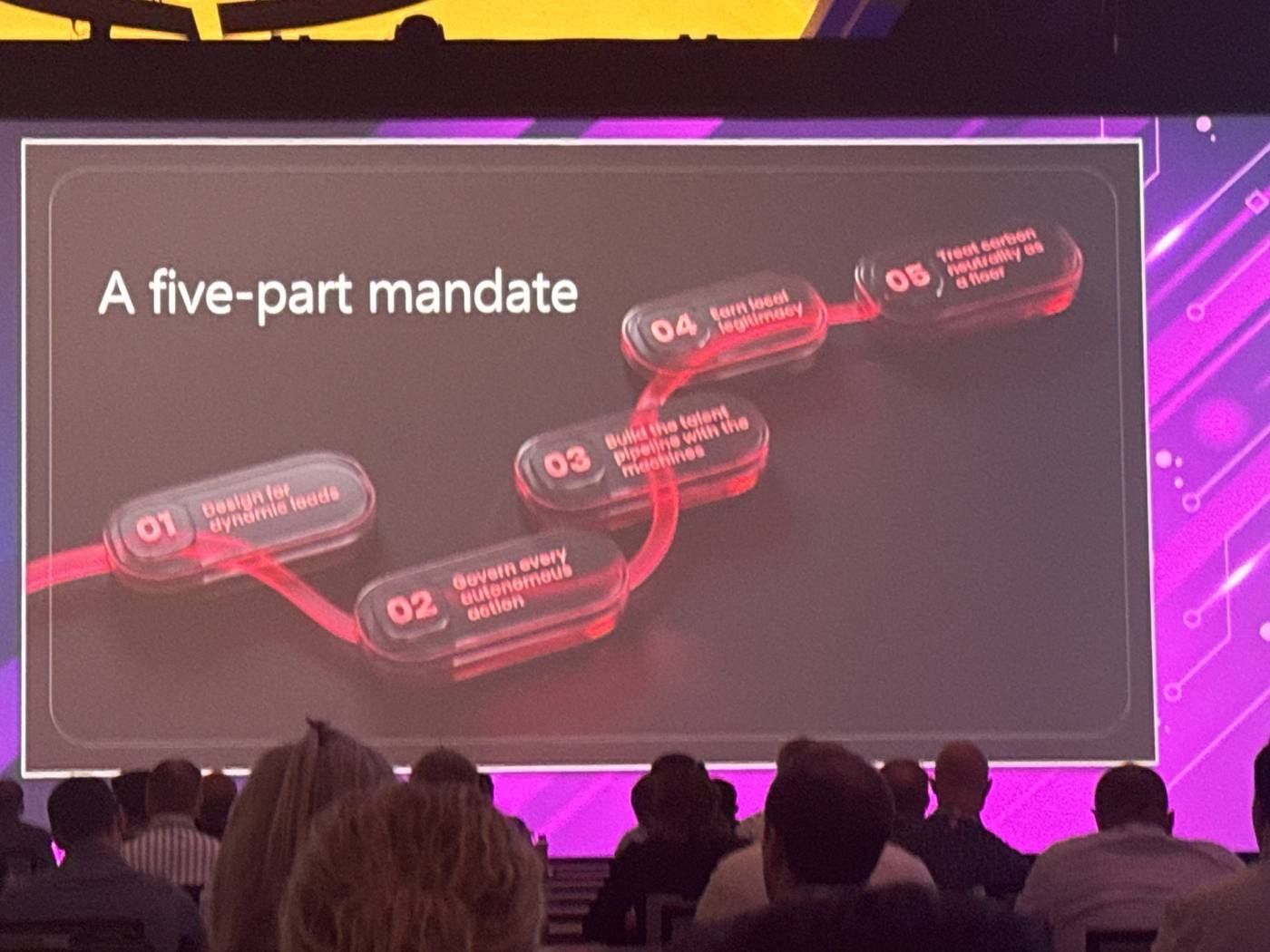
His closing mandate had five parts: design for dynamic loads, govern every autonomous action, build the talent pipeline alongside the machines, earn local legitimacy, and treat carbon neutrality as a floor.
Nabeel Mahmood's keynote (Nomad Futurist), 7x24 Exchange Fall 2026, photographed from the audience.
The second one is the one we think about most. If software is going to watch a five-nines facility, its behavior has to be measurable too: was the diagnosis right, did the fix hold, and did a person approve it before anything changed. That's a start on the metric the industry doesn't have yet.
His last slide: "Intelligence without empathy is entropy."