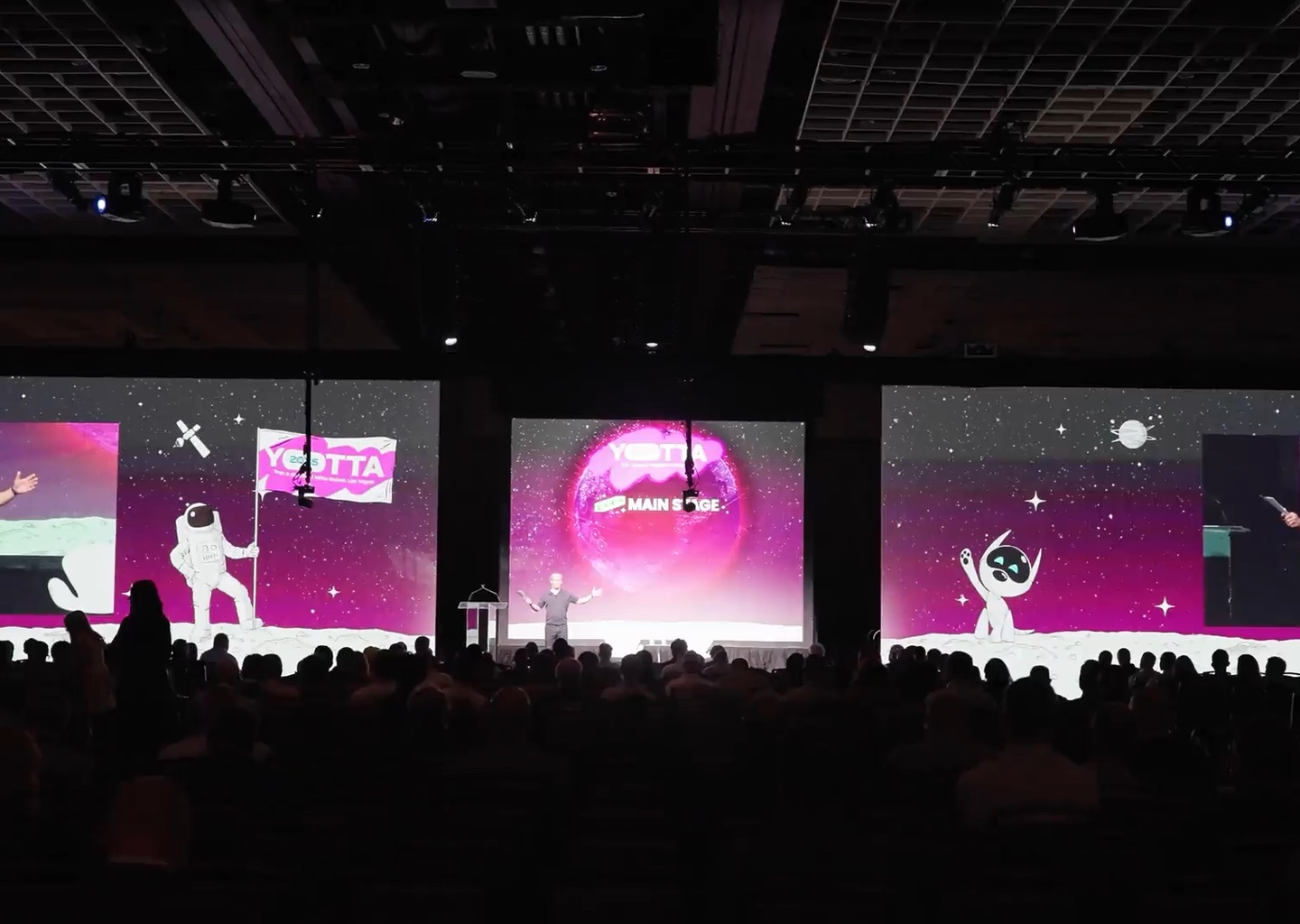
The fastest way to read a conference is its program. Yotta bills itself as the show where AI, energy and digital infrastructure converge, and the panels we caught on the first two days in Las Vegas read like a checklist of everything straining the AI build-out at once.
Cooling Under Fire
Part of the Cooling Summit hosted by Trane Technologies, with Keith Klesner (RadiusDC), Bruno Berti (NTT Global Data Centers) and Scott Tew (Trane Technologies), moderated by Rose Weinschenk of Uptime Institute.
A developer, one of the largest global operators, a cooling manufacturer and Uptime's research team on one stage is a fair picture of where cooling sits now: no longer a facilities detail but the constraint everyone is negotiating around as racks go liquid.
Data Center Design & Densification
Hosted by Lenovo, with Peter De Bock (Eaton), Ram Nagappan (Oracle Cloud Infrastructure), Vladimir Troy (NVIDIA) and Conor Malone (Lenovo).
Power equipment, a hyperscale cloud, the GPU maker and a server maker: the whole chain that has to agree before a denser rack can actually be built and fed.
Powering AI
At FuelCell Energy's stage, with Shankar Achanta, its chief product and technology officer. The subject was how fuel cells, batteries and UPS systems can be layered to absorb the fast power swings that GPU workloads put on a site.
The GPU Economy
Ignacio Quintana (MGX), Kfir Godrich (mAIndfulness), Cole Crawford (NATIVX) and Jason Tofsky (Goldman Sachs). The money side: who finances compute, on what terms, and what a GPU is worth over its life.
The Metrics That Matter
Hans Royal, an independent researcher, Orgil Batsaikhan (WTG Energy) and Ian Black (Freeman, LLC). A panel about what to measure when the old efficiency numbers stop describing an AI site, which is the same question the 7x24 Exchange keynote raised a month later.
The Token Wars
Mitesh Agrawal (Positron), Nikola Borisov (Deep Infra) and Jason Goodison (General Compute), moderated by Brian Beeler of StorageReview. Three companies building around inference rather than training, and around the cost of serving each token.
What we took from it
Read top to bottom, the program tells the story: heat, density and power on the facility side; capital, metrics and inference economics on the business side. None of those can be solved alone anymore. A cooling decision is a power decision is a financing decision, and the operators who can see their own facility clearly are the ones who get to make those calls with confidence.